Enemies to Lovers in K-Drama vs Western Romance Television
Korean and Western TV build the trope from different social conflicts.
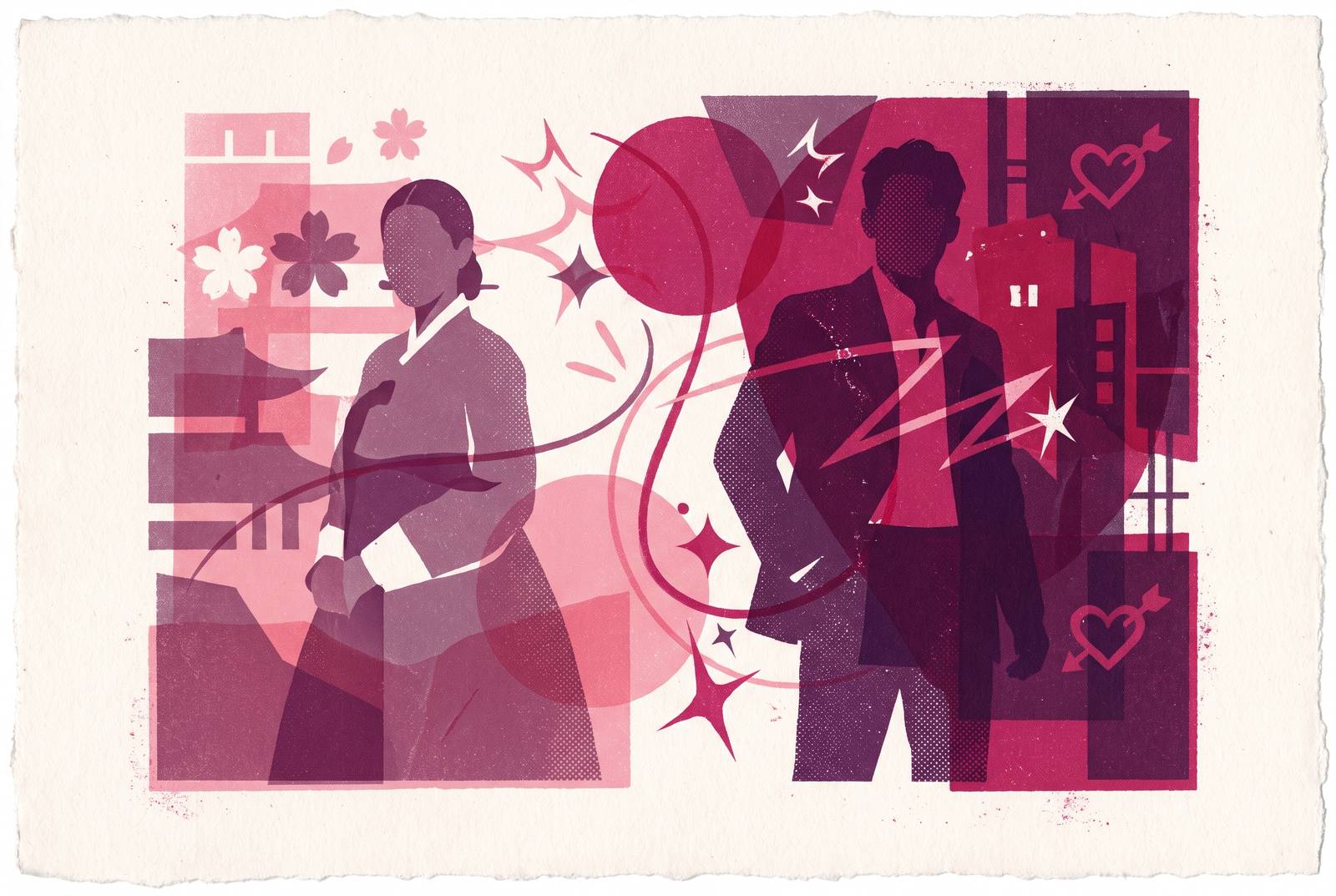
Enemies-to-lovers works because it asks two separate questions at once: when do these people stop fighting, and when do they start wanting each other? Those questions don't resolve together, and the gap between them is the whole engine of the trope. K-drama and Western romance television have built entire storytelling economies around that gap, but they've built different economies, with different pacing, different stakes, and different answers to what the hostility was ever about. The trope predates television by two centuries (Pride and Prejudice, published in 1813, gave one literary tradition a recognizable template, and other novels of the era gave it bleaker variations), but each tradition has run its own experiment on what happens when you keep the shape and swap the ingredients.
The emergence of "hyumgwan" as a recognized sub-genre
Korean viewers have a word for this now. "Hyumgwan," short for "hyumo gwangye," or hostile relationship, started as fan shorthand and has since hardened into something closer to a genre label, carrying more definitional weight than a simple shipping tag the way certain stock pairing terms function in another language's fan spaces.
The dynamic itself isn't new. Combative leads have a long history in Korean television. What changed is that audiences finally named the pattern and started studying it instead of just watching it play out. Yoon Seok-jin, who teaches Korean literature at Chungnam National University, has described hyumgwan narratives as working specifically because they put conflict between the leads at the center of the story and use that conflict to drive emotional transformation, rather than treating it as a delay mechanic bolted onto a separate romance plot.
Western television criticism has not coalesced around an equivalent term, and that means enemies-to-lovers keeps getting reused as an unnamed trope without the shared identity that a genre label like hyumgwan gives Korean fandom. Critics describe enemies-to-lovers constantly, but nobody has given it a genre name the way Korean fandom gave hyumgwan its own identity and internal critical vocabulary. Korean audiences treat the trope as a distinct mode of storytelling with its own internal rules. Western audiences treat it as a flavor inside other genres. That difference in vocabulary is the first sign the two traditions are doing structurally different work.
What makes characters enemies in K-drama: hierarchy, face-saving, and institutional conflict
The hostility rarely starts as personal, and that's the detail most casual viewers miss. K-drama leans on Confucian social structure, hierarchy, obligation to family, the constant work of saving face, and that framework generates conflict between characters before either one has done anything to actually deserve resentment. The animosity is inherited from the system they're standing in, not manufactured from scratch by the writers.
Workplace setups do most of the heavy lifting. Rank differences, professional rivalry, competing for the same promotion or the same case or the same surgery: all of that builds an adversarial floor under the characters before any personal dislike enters the picture. Add the smaller cultural registers on top, what counts as disrespect within a hierarchy built on obligation and face-saving, and minor infractions start reading as real provocations instead of throwaway friction.
Most hyumgwan pairs, as a result, don't actually hate each other. They misread each other, filtered through the social role each one is stuck performing. The apparent enemy is usually a colleague or rival forced into an antagonistic posture by rank, obligation, or a bad first impression that neither one bothers to correct. Genuine malice is rare in this format. Misunderstanding does almost all the work. That is why the reconciliation, once it comes, feels earned rather than convenient.
How K-drama paces the hostility-to-love arc, and what the slow burn is doing emotionally
K-drama tends to run one central enemies-to-lovers arc across a fixed span, typically a self-contained season of episodes, ending in a resolved conclusion. That's a structural choice with real consequences. The arc has a beginning, a shape, and a terminus, and everyone involved, writers and viewers alike, knows the story is building toward an ending rather than an indefinite middle.
The slow burn in this format comes from the gradual wearing-down of the social performance each character has been maintaining, the professional mask, the deference to hierarchy, the face shown at work and to family. Intimacy arrives as the place where that performance is no longer required, and that's the emotional payload the genre is actually selling, not the fighting itself. That's the emotional payload the genre is actually selling, not the fighting itself.
Doctor Slump makes this visible about as clearly as any recent example can. Both leads arrive already burned out, already having failed professionally in ways that strip their competitive personas down to nothing. Their hostility doesn't resolve through a dramatic confrontation scene. It dissolves gradually through quiet moments, through recognizing the same exhaustion in the other person's situation. The romance, when it lands, plays as relief rather than victory.
Alchemy of Souls runs the same engine at a different scale. The longer runtime lets the hostility dissolve in layers instead of all at once, and the soul-switching premise adds a wrinkle the workplace dramas don't have to deal with, layering questions of identity onto the emotional negotiation the format already demands.
How Western TV structures the same trope differently: multiple pairings, longer timelines, and class as the engine of enmity
Western television stretches the trope out rather than resolving it, and that's the real structural break from the K-drama model. Bridgerton is the clearest case: its anthology structure rotates a new enemies-to-lovers pairing into the spotlight every season, designed to be extensible rather than to close. It's extensible by design, built to run indefinitely rather than close.
Bridgerton Season 2, on Netflix, is the example most people reach for. Kate Sharma and Anthony Bridgerton spend the season at odds because Anthony is courting Kate's younger sister, and their enmity is rooted in social obligation and competing interests rather than straightforward professional competition. The obstacles are social and institutional, much like the hyumgwan setups, but the tone leans into scandal and visual excess rather than office hierarchy.
Period drama in the Western tradition generally puts class conflict and social scandal at the center of the enmity. The hostility on screen frequently masks vulnerability or social constraint the characters can't say out loud, rather than two people meeting as equals and clashing on equal footing. That's a meaningful distinction from the K-drama version: the Western hostility is usually about what a character cannot have, and the K-drama hostility is usually about what a character misread.
Six confirmed K-dramas where the trope plays out across meaningfully different subgenres and stakes
One romantic comedy built its entire premise on a fake-dating setup gone sideways, and the hostility there comes from a lie one lead is forced to keep maintaining against a boss who doesn't know he's actually her blind date.
Another entry runs the office version more straightforwardly, with rank and professional friction generating the central tension.
Destined with You, a 2023 drama with 16 episodes, leans further into discomfort, placing the show toward the harsher end of the hyumgwan spectrum rather than the gentler, comedic friction a lot of similar plots settle for.
Love Your Enemy, starring Jung Yu-mi and Ju Ji-hoon, is alongside The Trunk (Netflix, with Seo Hyun-jin and Gong Yoo) as part of the current wave of hyumgwan titles carrying the trope through Korean prestige television in 2025.
The Haunted Palace takes the trope into fantasy-historical territory, building its central hostility around a shaman's deep resentment toward a supernatural entity rather than a workplace or a marriage contract. It's been pulling weekend ratings near the high 9% range and landing consistently in Netflix Korea's Top 10, proof the hyumgwan formula travels well outside contemporary office settings.
These titles, spanning different institutional machines generating the same emotional shape, curse, prestige drama, historical fantasy, and others, are the strongest evidence hyumgwan is a genre convention rather than a coincidence of a few popular shows.
The toxicity debate: how it differs between K-drama and Western contexts
Both traditions face a version of the same complaint: enemies-to-lovers can dress up bullying, guilt-tripping, or obsessive pursuit as romantic instead of naming it as coercive. Whether a healthy relationship can actually grow out of that history stays a live question in both critical conversations, not a settled one, and the two fandoms argue about it in different places for different reasons.
The K-drama version of this debate plays out largely in fan spaces like MyDramaList, where the argument centers on where legitimate hyumgwan tension ends and genuinely toxic male-lead behavior begins. Manhandling, verbal sparring that curdles into cruelty, emotional manipulation dressed up as passion: all of it gets litigated scene by scene. Destined with You comes up repeatedly in these conversations, precisely because its male lead's coldness is written to feel real rather than performative.
Western criticism points somewhere else entirely: at the power asymmetry baked into the period setting itself. Class, gender, and property law mean the enmity between a couple in a certain period-drama mold often conceals a radically unequal social position. What plays on screen as spirited resistance from the female lead may actually be a response to constraints the show renders beautiful instead of examining.
The blind spot each tradition produces is different, and that's the more useful way to read the toxicity debate than treating it as one universal complaint. K-drama criticism zeroes in on individual male behavior, judged against the Confucian hierarchy the genre already takes as its backdrop. Western criticism zeroes in on the structure itself: the class and legal architecture the period-drama aesthetic tends to romanticize rather than question.
Netflix as the platform where both traditions now meet and cross-pollinate in practice
Korean content stopped being a niche interest on Netflix a while ago. More than 80% of the platform's global members have streamed a Korean title, a number that makes the old "guilty pleasure" framing obsolete at this point.
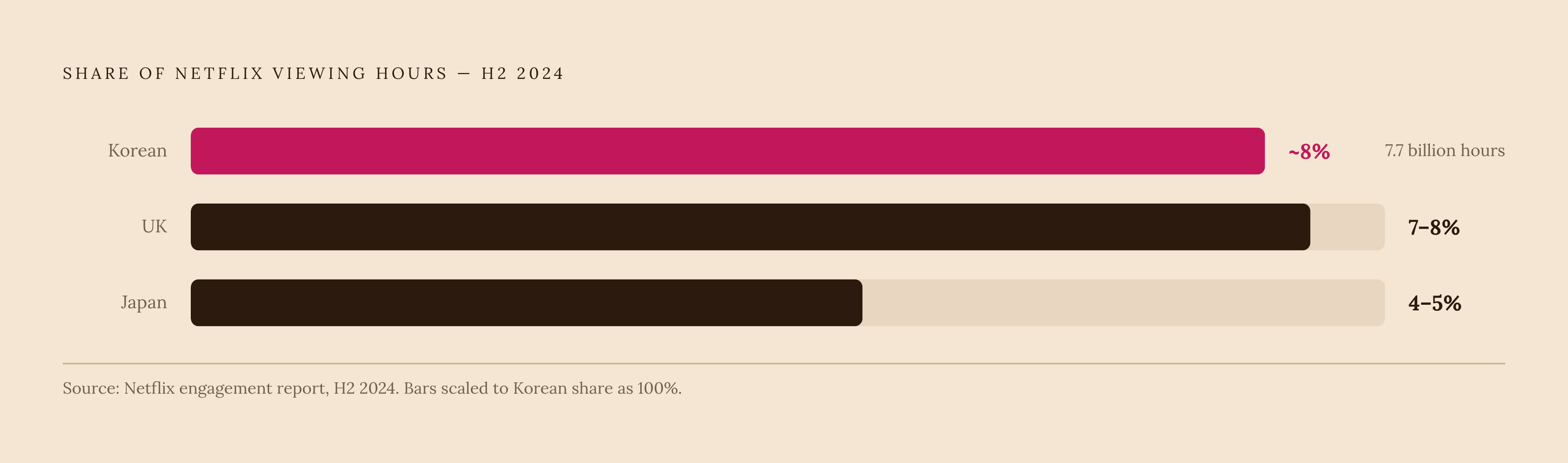
South Korean programming has ranked second only to US content in total global viewing hours on Netflix since 2023. In the second half of 2024 alone, Korean content racked up 7.7 billion viewing hours, around 8% of everything watched on the platform, ahead of the UK's 7 to 8% share and well ahead of Japan's 4 to 5%.
The growth isn't confined to Asia, either. Southeast Asia's premium video-on-demand market added more than 1.5 million net new subscribers in the second quarter of 2025, with Korean dramas pulling in 35% of total viewing hours across the region that quarter. The growth pattern beyond Asia reflects how broadly Korean content has embedded itself across the platform's global audience.
That overlap is exactly the condition under which two storytelling traditions start borrowing from each other on the same platform, in front of the same audience: pacing habits, character types, even structural choices start crossing over. A viewer of one period drama who wanders into another romantic comedy is watching the same trope run through a completely different institutional logic, and a streaming platform's recommendation engine is the delivery mechanism making that collision routine rather than accidental.
How short-form vertical drama accelerates and stress-tests the enemies-to-lovers arc
Short-form vertical drama is where the enemies-to-lovers formula gets compressed to its most concentrated form, and it's the clearest stress test either tradition has faced. Hate You Hard, Love You Harder is one title built explicitly on that blend, combining K-drama emotional instincts with the rapid-fire, addictive rhythm vertical-screen storytelling demands.
Where a K-drama takes ten to twenty episodes to erode a character's social performance, the short-form format has to manufacture the same emotional turn in a fraction of that time, minutes rather than hours. That compression puts real pressure on the trope's core mechanics. If the slow burn is fundamentally about watching two people's guard come down gradually, a vertical drama has to suggest that erosion almost instantly, without the runway a full season provides.
Most vertical dramas don't solve this problem so much as skip it. They compress the hostility phase down to a handful of scenes and lean on archetype recognition, rather than accumulated detail, to sell the turn. That's not a failure of the format; it's a different bet entirely: speed over accumulation, recognition over erosion. Whether that produces something structurally new, or just a rushed version of the same old shape, is the question the format is currently answering in real time, one thirty-second episode at a time.