Fake Dating Trope Mechanics and Reader Appeal
How fake dating became romance's most reliable emotional mechanism.
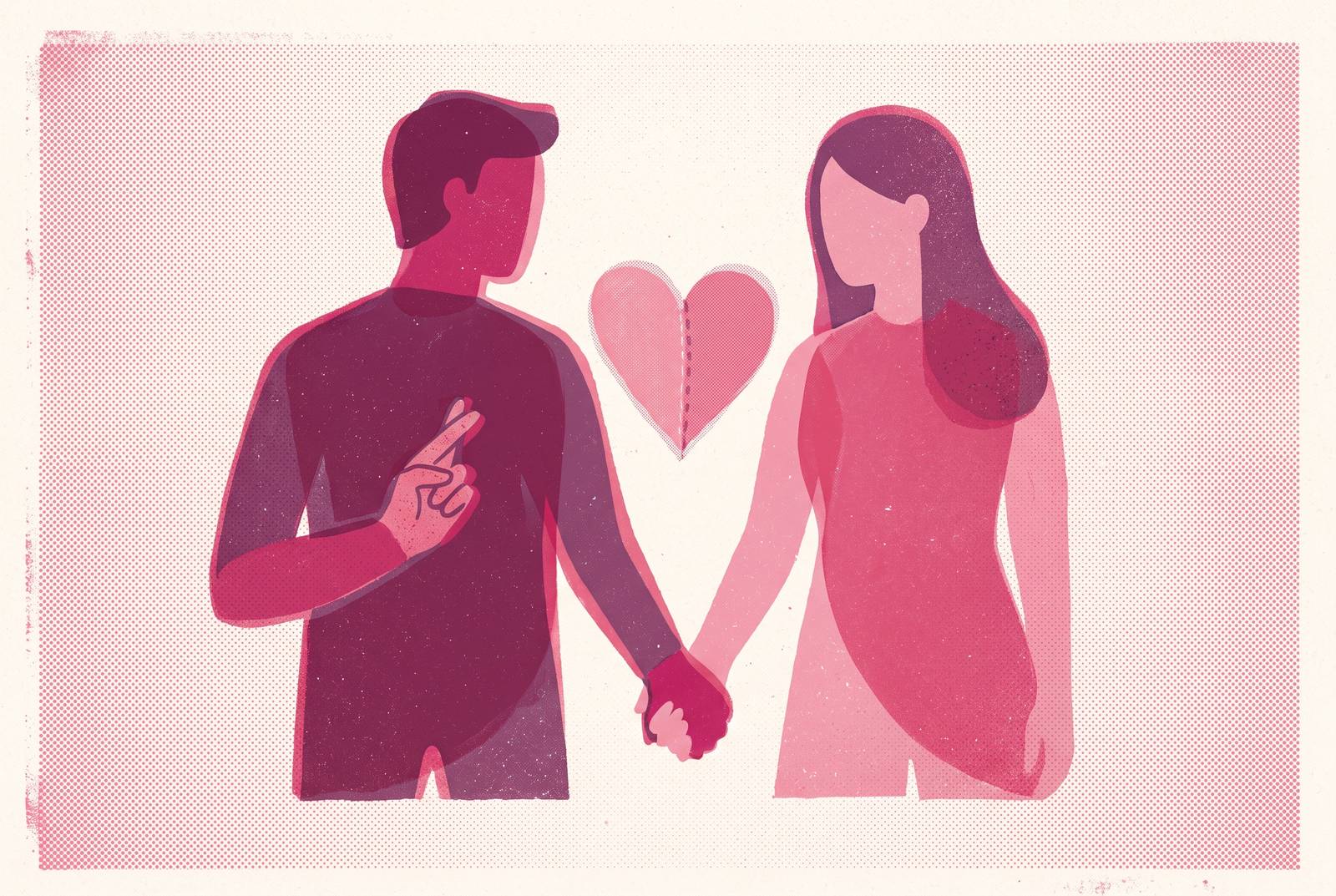
The permission structure. The contract gives characters cover to be intimate before they're ready to be vulnerable on purpose. A character can say "I love you" out loud because someone's supposed to be listening. Two characters can share a bed because the story requires it, not because either one asked. That fiction becomes a rehearsal space for truth, and by the time either character admits anything to themselves, they've already been living the emotional reality for chapters.
What fake dating is and why the contract at its center is load-bearing
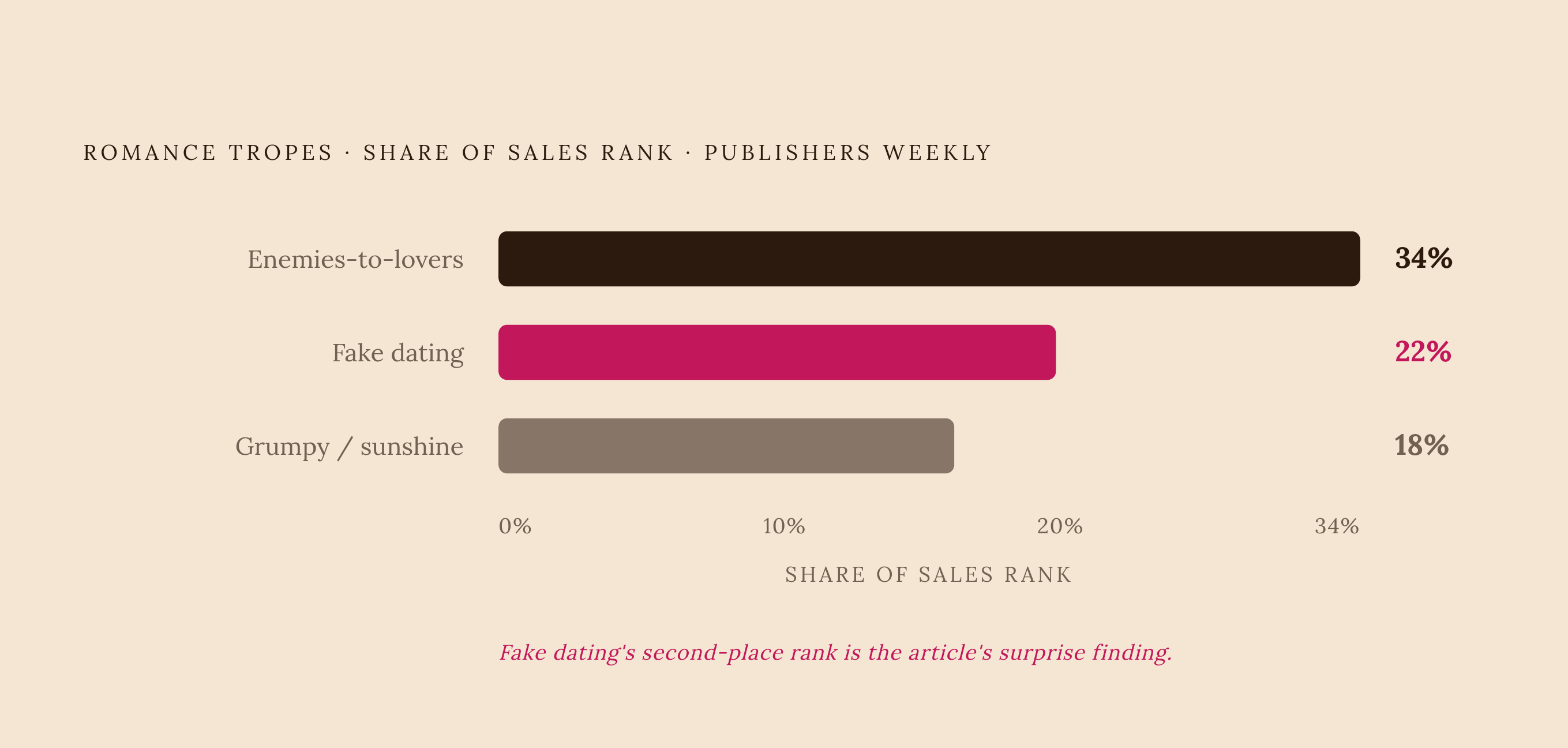
Romance is the biggest engine in print fiction right now, and fake dating is one of its most reliable pistons. According to Publishers Weekly, fake dating accounts for 22% of top-selling romance tropes, trailing only enemies-to-lovers at 34% and beating grumpy-versus-sunshine at 18%. A large share of BookTok users report that repetitive tropes actively influence their reading choices. Trope recognition works less like a genre label and more like a purchase trigger. Fake dating earns its shelf space because the structure keeps paying off, book after book.
The setup sounds simple: two characters agree to perform a romantic relationship for reasons that have nothing to do with romance, and the performance slowly turns into the real thing. But the romance isn't what holds the story up. The agreement is.
A fake dating story needs explicit ground rules, a stated endpoint, and mutual consent to the lie. If that is stripped out, there is no premise left, just two people thrown together with no reason to stay in the same room once the scene ends. The rules matter because they're going to get broken, and a rule that was never really a rule can't be broken in a way that means anything. A practical trigger forces the arrangement, rules get set, the public performance starts leaking into private feeling, the line between pretend and real blurs, and then a reckoning arrives when the contract is supposed to expire.
The contract also does quieter work. Because both people agreed to the fiction, neither one is deceiving the other, which frees the story to let them get physically and emotionally close without the reader feeling like anyone's being wronged. That's a meaningfully different register from the one-sided version of this trope, where only one party knows the relationship is fake, and the story has to answer for that imbalance in ways mutual-consent fake dating never does.
How the trope has been staged across a century
Fake dating didn't arrive with BookTok. It shows up in It Happened One Night, runs through screwball comedy in the 1940s (The Lady Eve is a clean example), turns up in 1950s musicals, resurfaces in 1980s high school movies, and keeps going from there into contemporary romance publishing.
The device went quiet for a stretch in the 1960s and '70s. That gap matters: fake dating isn't just always sitting around waiting to be picked up, it gets revived when something in the culture makes the specific dishonesty of it resonate again.
There's a harsher branch of the family tree: the one-sided version. In the one-sided version, only one character knows the relationship is fake, usually because of a bet or a scheme, and the other is genuinely deceived. That lineage runs through Dangerous Liaisons and its 1999 update, Cruel Intentions, and it carries a moral weight the mutual-consent version never has to answer for. Anyone But You pulled its premise loosely from Shakespeare's Much Ado About Nothing, a reminder that this device is centuries old and just keeps changing costumes.
The six psychological mechanisms that make fake dating feel almost engineered for reader pleasure
These are mechanisms. Each does a distinct job, and readers can usually name which one is working on them at any given moment.
Dramatic irony does the heaviest lifting early on. Readers know, usually by chapter three, that the feelings are going to become real. The characters don't know it, or won't admit it. Every fake kiss that lasts a beat too long, every hand-hold that shifts from performance to something a character actually needed, lands harder because the reader is always ahead of the page. The gap between what a character says ("this isn't real") and what a character is clearly starting to feel ("this hasn't been fake for weeks") produces the exact friction that keeps someone turning pages just to watch a character catch up to what's obvious.
The contract also functions as a permission structure. It gives characters cover to be intimate before they're ready to be vulnerable on purpose. A character can say "I love you" out loud because someone's supposed to be listening. Two characters can share a bed because the story requires it, not because either one asked. That fiction becomes a rehearsal space for truth, and by the time either character admits anything to themselves, they've already been living the emotional reality for chapters. It works the same way on the reader, watching two people's guards drop without either one performing early-dating anxiety reads as more honest than a normal courtship ever could.
Then there's forced intimacy logistics. Selling the lie means doing the boring, specific work of a relationship: holding hands in public, sharing a hotel room, learning how the other person takes their coffee, meeting the family, getting the cover story straight before dinner. None of that is dramatic by itself. It's charged because both characters know, or are trying hard not to know, what they're supposedly not feeling while they do it. Author Jean Meltzer has described the trope as an amped-up metaphor for falling in love, and that's precisely the mechanism: the ordinary tasks of coupledom, performed under false pretenses, do double duty as courtship.
The trigger scenarios that set these mechanisms in motion
The trigger is whatever forces two people into the arrangement, and the genre pulls from a fairly fixed set: avoiding an ex at a wedding, managing a family that won't stop asking about your love life, protecting a career, meeting the conditions of an inheritance, going undercover to catch a criminal, granting a dying relative's last wish, convincing an immigration officer a marriage is genuine.
That range is part of why the trope travels so well commercially. The same emotional machinery runs across a contemporary office romance, a Regency ballroom, or a fantasy world with a golem standing in for a fiance. The costume changes. The engine underneath doesn't.
A trigger that only handles logistics is doing half its job and stopping there. It has to give both characters an airtight reason to keep pretending even as real feeling starts complicating things, because a flimsy premise collapses under its own weight before the emotional payoff has time to build. Readers will tolerate a wildly implausible setup: fooling a government official, summoning a golem to pose as a fiance, whatever the premise demands. What they will not tolerate is a premise that fails to reveal who these people actually are. A trigger's real job is to illuminate character, not just manufacture proximity, and that's the test most fake dating novels actually fail.
How the trope's variants, fake engagement, marriage of convenience, undercover lovers, redistribute the emotional weight
Fake dating splits into recognizable sub-genres, and each one moves the stakes around differently. They are not interchangeable, and picking the wrong one for a given premise is a structural mistake, not a matter of taste.
Fake engagement adds a countdown. Planning a wedding that isn't supposed to happen forces both characters to imagine a shared future while insisting, out loud, that none of it means anything, which pushes intimacy further and faster than a casual fake-dating arrangement ever could. Family involvement compounds it: in-laws to win over, showers to attend, logistics that pull characters into domestic territory a looser arrangement never reaches.
Marriage of convenience is the most formal version, a legal partnership built around a practical need like inheritance, immigration status, or social standing. Because marriage is genuinely hard to exit, the stakes sit higher than in any arrangement someone can just walk away from, and that permanence opens up questions about identity and self-determination that lighter variants never have to touch. This is the variant with the most at stake, and it should be reserved for stories that actually want to interrogate what a legal bond does to two people who didn't choose each other for love.
Undercover as lovers bolts the fake relationship onto a genre mission, catching a criminal, infiltrating a social circle, and that mission runs on its own clock alongside the emotional one. Exposure here doesn't just end a relationship. It blows the operation, which adds a professional consequence none of the other variants carry.
Fake exes is the smaller, sharper cousin: two people who never actually dated invent a shared romantic history. There's no real past to protect, only a fabricated one, so the characters build intimacy around a lie about what already happened rather than a lie about what's happening now.
The moment the pretense breaks
The confession scene is one of the few moments in romance fiction where a character has to declare real feelings with no guarantee the other person has stopped performing. That's genuine vulnerability, not manufactured conflict, because the character confessing has no way of knowing whether they're about to be humiliated.
The payoff, when it lands, works on two levels at once. For the characters, it's the experience of being loved and accepted at their most unguarded. For the reader, it's the release of everything the six mechanisms have been building toward. Author Vanessa Riley has framed the reader's core question as "when does it feel real? When will it become real?", and the confession scene is the single moment built to answer both at once.
For that turn to land, the exposure of the lie needs real consequences, not an awkward conversation smoothed over in a page. The relationship was built on a fiction, so when that fiction collapses, trust, a job, or a family relationship has to genuinely break before it can be rebuilt on honest terms. If the fracture is skipped, the ending feels unearned no matter how well the confession itself is written.
What separates a compelling execution from a flat one
The clearest way to see what makes this trope work is to look at how it fails, and it fails in three specific, avoidable ways.
A flimsy premise kills the book before the emotional work even starts. If the setup doesn't survive basic scrutiny, readers check out. Both characters need a reason to keep pretending that still holds up as feelings intensify.
Feelings that appear from nowhere are the second failure. Without the slow accumulation of forced intimacy, the shift from pretend to real reads as arbitrary rather than earned. The mechanisms described above only work if they're allowed to build over time; no single scene can do that work by itself, no matter how well it's written.
The third failure is episodic hijinks with no escalation, a string of fake-relationship set pieces that never raise the stakes and just recycle the same beat until it goes flat. The Spanish Love Deception by Elena Armas has drawn criticism on exactly this point: stretches of the middle revisit similar emotional territory without shifting the dynamic, so the tension reads as stretched thin rather than rising. Chemistry between two characters can carry a scene. It cannot carry an entire book, and mistaking one for the other is the single most common way this trope goes wrong.